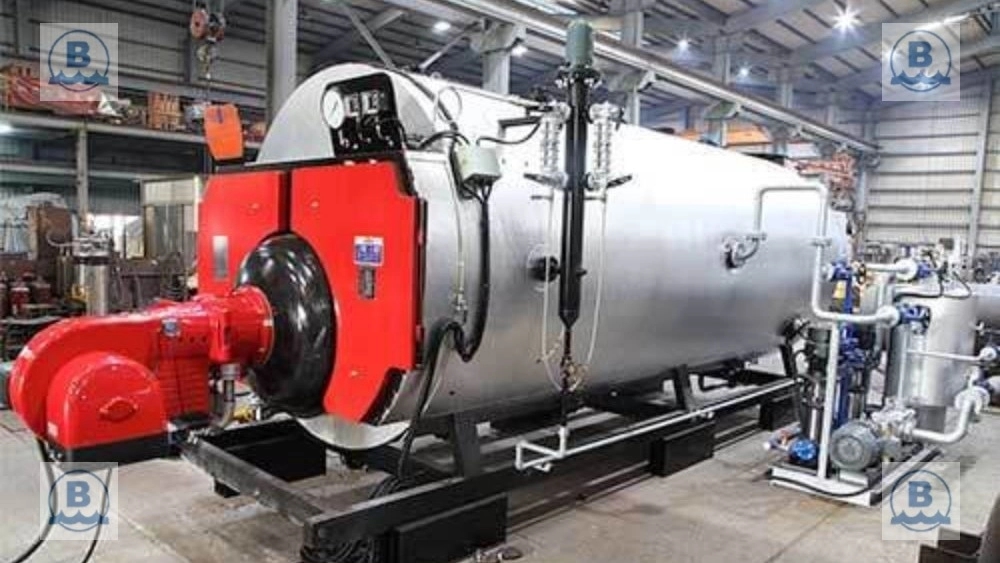
Training to calculate the capacity of hot oil boiler based on flow rate, ΔT and type of process
formulas; Industrial examples (bitumen/food/textile); Common sizing errors
The correct capacity measurement of the hot oil boiler is the basis of the design of an efficient and economical heating system. With an educational tone, this article introduces engineers and managers of bitumen industries with the concepts, main formulas and practical steps of calculating the required capacity. The final goal is to accurately determine the required thermal power (in kilocalories per hour) to ensure the optimal performance of the production line.
Definition of basic parameters in capacity selection
Before entering into the calculations, the basic parameters of the system should be identified:
- Process heat load ($Q_P$): Total energy required to heat raw materials and maintain equipment temperature.
- Environmental heat loss ($Q_L$): Heat loss through the insulated body of the boiler, piping and storage tanks.
- Efficiency Thermal (${\eta}$): The efficiency of converting fuel into useful energy in the boiler (usually between 0.85 and 0.92).
- Safety Factor: A factor to cover fluctuations in consumption or loss of efficiency over time (usually 10 to 20 percent).
The required final capacity of the boiler ($Q_{\text{Boiler}}$) is a function of the sum of these parameters.
The main design formulas
The required capacity of the boiler (in kilocalories per hour) is calculated through the following formula:
[ Q_{\text{Boiler}} = \frac{Q_P + Q_L}{{\eta} \times SF} ]
where $SF$ is the confidence factor (e.g. 1.15 for 15% confidence).
Calculation of process heat load ($Q_P$)
$Q_P$ consists of two main parts: heating raw materials and maintaining temperature.
1. Heating Up:
If it is necessary to heat a mass of material (such as bitumen) with a mass of $M$ (kg), with a temperature difference of $\Delta T$ (centigrade) in a certain time $t$ (hours), the required power is calculated as follows:
[ Q_{\text{Heat}} = \frac{M \times C_p \times \Delta T}{t} ]
where $C_p$ is the specific heat capacity of the substance (about 0.5 kcal/kg °C for bitumen).
2. Heat Maintenance:
This thermal load is to compensate for heat loss from tanks and pipelines at operating temperature. This value should be obtained through the equipment's physical specification table or experimental measurement.
Numerical example for a bitumen plant with specific heat consumption
Suppose an asphalt factory needs the following:
- Daily heating of 50 tons of bitumen from 20°C to 160°C in 8 working hours.
- Maintaining the overall temperature of the system (tanks and pipes) at 160°C, which is equivalent to a constant heat loss of 500,000 kcal/hour.
- Expected thermal efficiency of the boiler: ${\eta} = 0.90$.
- Confidence factor: $SF = 1.15$.
Step 1: Calculation of initial heating load (Heating Up):
bitumen mass $M = 50,000 \text{kg}$. $\Delta T = 160 - 20 = 140^\circ\text{C}$. $C_p = 0.5$. Warm-up time $t = 8 \text{hours}$.
[ Q_{\text{Heat}} = \frac{50,000 \times 0.5 \times 140}{8} = 437,500 \text{ kcal/h} ]
Step 2: Calculation of heat maintenance load:
[ Q_{\text{Loss (Total)}} = 500,000 \text{ kcal/h} ]
Step 3: Calculation of the total required heat load of the process ($Q_P$):
[ Q_P = Q_{\text{Heat}} + Q_{\text{Loss (Total)}} = 437,500 + 500,000 = 937,500 \text{ kcal/h} ]
Step 4: Calculate the final capacity of the boiler:
[ Q_{\text{Boiler}} = \frac{937,500}{0.90 \times 1.15} \approx 1,138,759 \text{ kcal/h} ]
Therefore, the required hot oil boiler capacity should be at least 1.14 million kilocalories per hour.
Common errors in calculations and their correction method
- Ignoring heat loss from pipes: Long pipes between boilers and tanks can create a significant loss load. Correction: Always calculate the heat loss of the pipes separately and add to $Q_L$.
- Choosing an overly optimistic efficiency: Use an efficiency of 95% for a boiler that actually runs on old oil. Correction: Always use the actual efficiency of the system (based on the manufacturer's certificate) and include the safety factor.
- Not including the stop time (Batch Time): If the production is batch (Batch), the heating time should be properly timed in the calculations.
Using engineering calculation software
Reputable companies such as Vachar Niro use specialized software based on ASME or TEMA standards to simulate heat flow, heat transfer in coils and thermal stresses so that the calculated capacity remains stable in the real environment.
FAQ capacity calculation
- Does the type of fuel (diesel or natural gas) affect the calculated capacity?
The type of fuel does not directly affect the thermal capacity of the boiler (kcal output), but it affects the required input power of the burner and the operating cost, because the heating value of the fuels is different. - What is meant by the reliability factor (SF) in capacity measurement What is it?
The safety factor is a margin to compensate for uncertainties, loss of efficiency during the life of the device or temporary unforeseen needs (such as starting work at a very low ambient temperature). - What happens if we buy a boiler larger than the required capacity? Cycling). This reduces the efficiency, increases the wear of the burner parts and leads to carbon deposition in the coils.